NAND theorem
Youtube
#The NAND Gate
| A | B | OUT |
|---|---|---|
| 0 | 0 | 1 |
| 0 | 1 | 1 |
| 1 | 0 | 1 |
| 1 | 1 | 0 |
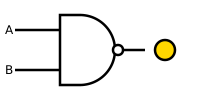
Above is the NAND gate(aka NOT AND), which outputs 0 if and only if both inputs are 1, and outputs 1 otherwise. It looks like an AND gate, just with a bubble at the end, which represents the NOT operation.
#Building the NAND Gate
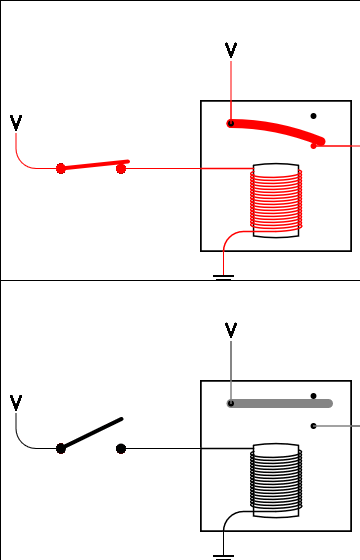
We can build a NAND gate by cleverly arranging Relays. Relay’s have a wire wrapped around an magnetic rod. When electricity runs through the coil, it creates a magnetic field that can pull down a lever which then outputs electricity depending.
Your task is to build all of these gates starting only from a NAND gate. Once you’ve successfully built a gate, you may use it as a building block for the gates that follow.
For example:
First, build the Not gate using only NAND gates.
After that, you may use both NAND and Not gates to build the And gate.
Continue this process for the remaining gates.
It is highly recommended to follow the order listed above, since the gates become progressively more challenging as you move down the list.